
Reliance Industries was the top gainer in the Sensex pack, rising over 1 per cent, followed by M&M, HCL Tech, Axis Bank, ICICI Bank and HUL. On the other hand, Bharti Airtel, Maruti, SBI, PowerGrid, NTPC and Tata Steel were among the laggards.

In a bull-case scenario it sees the Sensex at 61,000 levels, while it's bear case scenario pegs the Sensex at 41,000 levels by December 2021.

After falling 10 per cent against the greenback in 2022, the rupee staged a comeback in 2023 as it appreciated, albeit marginally, on the back of strong portfolio inflows, in addition to timely intervention by the Reserve Bank of India. The Indian unit appreciated by 0.16 percent in six months until June 28. The rupee stood in third place in terms of appreciation against the US dollar among the 12 Asian currencies and in 12th place of the 23 emerging-market currencies.

Reinvent and innovate will be the key mantra for the Indian pharma industry in the New Year as the 'pharmacy of the world' looks to move from volume to value leadership, amid emerging challenges of inflation and pricing pressures in the global markets. While R&D investment, market competitiveness, regulatory scrutiny, and domestic price regulations are expected to shape the growth of generics and injectable products, concerns such as price control and customs duties on medical equipment will continue to bother the healthcare industry in 2023. The industry believes that in view of India's G20 Presidency, digital health innovation, achieving universal health coverage, improving healthcare infrastructure and delivery will continue to be the key driving factors in 2023.

The Nifty IT has been one of the worst-performing indices on the bourses this calendar year. Rising concerns of a potential global recession, which investors fear can dampen demand for export-facing domestic information technology (IT) giants, have sent the index down over 30 per cent on a year-to-date basis. By comparison, the Nifty50 Index has shed 2.8 per cent during the period, reveals data by ACE Equity.

'In the overall global portfolio, India's weighting has come down in the past seven months.'

Indian equity markets registered their highest single-day percentage gains since early October.

Mutual funds (MFs) are seeing higher growth in new systematic investment plan (SIP) accounts in rural areas (beyond 30 or B30 centres) compared to the top 30 (T30) cities. However, the average inflows from these areas remain significantly lower than those from the larger centres. Data from the Association of Mutual Funds in India reveals that investors from B30 contributed Rs 1,725 on average to MFs through SIPs, which is 70 per cent lower than the average ticket size of T30 investors at Rs 2,940.


Reliance Industries Ltd on Friday reported a 27 per cent jump in its September quarter net profit as earnings from the oil and gas business rebounded, and a pick-up in fashion and grocery helped boost retail revenues. The oil-to-retail-to-telecom conglomerate's consolidated net profit of Rs 17,394 crore, or Rs 25.71 per share, in July-September - the second quarter of the current 2023-24 fiscal - was 27.3 per cent higher than Rs 13,656 crore, or Rs 19.92 a share, earning a year back, the company said in a statement. The net profit was also higher quarter-on-quarter compared to Rs 16,011 crore earnings in the preceding three months ended June 30.

SBI was the top loser in the Sensex pack, shedding over 1 per cent, followed by Reliance Industries, Tech Mahindra, M&M, L&T, Bharti Airtel, IndusInd Bank and HDFC. NSE Nifty slipped 31.60 points to 15,824.45.

Billionaire Mukesh Ambani's Reliance Industries Ltd is the most valuable private company in the country, as per Hurun India's 2022 Burgundy Private Hurun India 500 list. The list, which was released on Tuesday, stated that with a value of Rs 16.4 lakh crore, Reliance is India's most valuable company, followed by Tata Consultancy Services (TCS) with Rs 11.8 lakh crore and HDFC Bank with Rs 9.4 lakh crore. Reliance is also the highest taxpayer with a payout of Rs 16,297 crore and the most profitable company with a bottomline of Rs 67,845 crore in 2022-23.

RBI will take a cue from the Fed policy statement.

Petrol and diesel prices were cut by Rs 2 per litre each as state-owned oil companies ended a nearly two-year-long hiatus in rate revision, just hours before the general election schedule was announced.


Analysts remain selective on cement stocks amid the likely government's capex push ahead of the scheduled general elections in May 2024. While UBS has initiated coverage on the Indian cement sector with an anti-consensus negative view and suggests investors sell select cement stocks on a rally, those at Nomura remain selectively bullish on the sector and prefer companies with large brownfield optionality and multi-region presence. In the near-term, UBS expects strong earnings of cement companies in the next two quarters to be driven by robust demand and margin tailwinds, but suggests any sharp uptick in stock prices could offer a good opportunity for booking profits in the related counters.

A sharp fall in the price of Bitcoin and other cryptocurrencies is another hard blow to the already sinking cryptocurrency market in India. Global and domestic prices have been on a downward trail since November last year when Bitcoin prices hit a peak of close to $68,000 in international markets. The recent past has seen a much sharper fall in the price of the leading cryptocurrency, Bitcoin.

Petrol and diesel price hikes are likely to resume after state elections get over next week to bridge the Rs 9 a litre gap created by international oil prices soaring past $100 a barrel. International crude oil prices shot above $110 a barrel for the first time since mid-2014 on fears that oil and gas supplies from energy giant Russia could be disrupted, either by the conflict in Ukraine or retaliatory western sanctions. The basket of crude oil India buys rose above $102 per barrel on March 1, the highest since August 2014, according to information from the Petroleum Planning and Analysis Cell (PPAC) of the oil ministry.

While the economy seems to be on a firm growth path, the fight against inflation is not over yet. Shaktikanta Das seems to be in no hurry. After playing well through a five-year Test match, he doesn't want to get out hit wicket, observes Tamal Bandyopadhyay.

Stock market barometers Sensex and Nifty ended marginally higher on Monday as rise in wholesale inflation capped early gains despite a positive trend in global markets. The 30-share index settled 32.02 points or 0.05 per cent higher at 60,718.71 with half of its constituents ending in green. The broad based Nifty edged up 6.70 points or 0.04 per cent to close at 18,109.45.

At the annual general meeting of Reliance Industries earlier this week, Isha Ambani, director at Reliance Retail Ventures, announced that the company is foraying into the fast-moving consumer goods (FMCG) space. But analysts say that only time will tell if this will lead to a disruption in India's FMCG market. While Reliance Retail's initial strategy is to take its own brands, which it currently sells at its own supermarkets and hypermarkets, to general trade, it is also looking at acquisitions.

The value of the foreign portfolio investors' (FPI) holdings in the domestic equities reached $667 billion in three months ended September 2021, a surge of 13 per cent from the preceding quarter, according to a Morningstar report. This was largely on the back of strong performance by the Indian equity markets along with net inflows from FPIs at the later part of the quarter. "At the end of the quarter ended September 2021, the value of FPI investments in Indian equities shot up sharply to $667 billion, which was considerably higher than the $592 billion recorded in the previous quarter, a spike of around 13 per cent," the report noted.

Experts tell Ujjval Jauhari that investors need to be careful in picking stocks given high valuations and with markets possibly ignoring potential risks

Markets will be closed on Thursday and Friday on account of Holi and Good Friday, respectively.

NTPC was the top gainer, spurting 4.28 per cent. Other winners were Bajaj Auto, Bajaj Finance, Sun Pharma, ITC, Hero MotoCorp, TCS, Yes Bank, HDFC, HDFC Bank and SBI, rising up to 1.38 per cent.

West Asian carriers are up against Air India and IndiGo in the battle for seats on lucrative international routes.
Equity benchmark Sensex rallied 936 points on Monday, helped by heavy buying in banking and IT counters along with decline in oil prices amid hopes of headway in renewed diplomatic talks between Russia and Ukraine. A fresh round of talks is expected on Monday between Ukrainian and Russian officials. Rising for the fifth straight session, the BSE Sensex jumped 935.72 points or 1.68 per cent to settle at 56,486.02.
After a positive opening, the 30-share BSE Sensex suddenly faced selling pressure in late-afternoon trade. It finally settled just 5.67 points, or 0.01 per cent, lower at 39,586.41.

IT major TCS CEO Rajesh Gopinathan has reigned, and the company nominated its global head of the BFSI division K Krithivasan as the CEO Designate with immediate effect, the firm said on Thursday. Gopinathan will continue with the company till September 15, 2023, to provide transition and support to his successor.

Billionaire Mukesh Ambani's Reliance Industries Ltd on Friday reported a 46 per cent jump in net profit for the three months ended June on the back of bumper earnings from oil and telecom businesses. The oil-to-retail-to-telecom conglomerate's consolidated net profit rose to Rs 17,955 crore during April-June period -- the first quarter of 2022-23 fiscal year -- from Rs 12,273 crore in the year-ago period, it said a stock exchange filing.
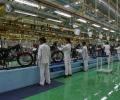
Riding on an improved show across parameters, TVS Motor (TVS) outperformed larger two-wheeler peers Hero MotoCorp (Hero) and Bajaj Auto (Bajaj) during the September (Q2 of FY23) quarter. The Chennai-based firm, which has the most-diversified portfolio among two-wheeler majors, posted a 28 per cent jump in revenues. This compares to 18 per cent growth for Bajaj Auto and single-digit uptick for Hero MotoCorp.

Even as domestic passenger car sales declined 29.4 per cent between April and August this year, exports grew 6.5 per cent, partially cushioning the blow from slowing sales.
